Just recently, during an Olympic weightlifting session, I listened to a sermon by Josh Howerton about the truth of hell.
It’s not uncommon to listen to a podcast while lifting or working out, but not the nuts and bolts of this message.
What this message is about, though, is how he introduced the sermon.
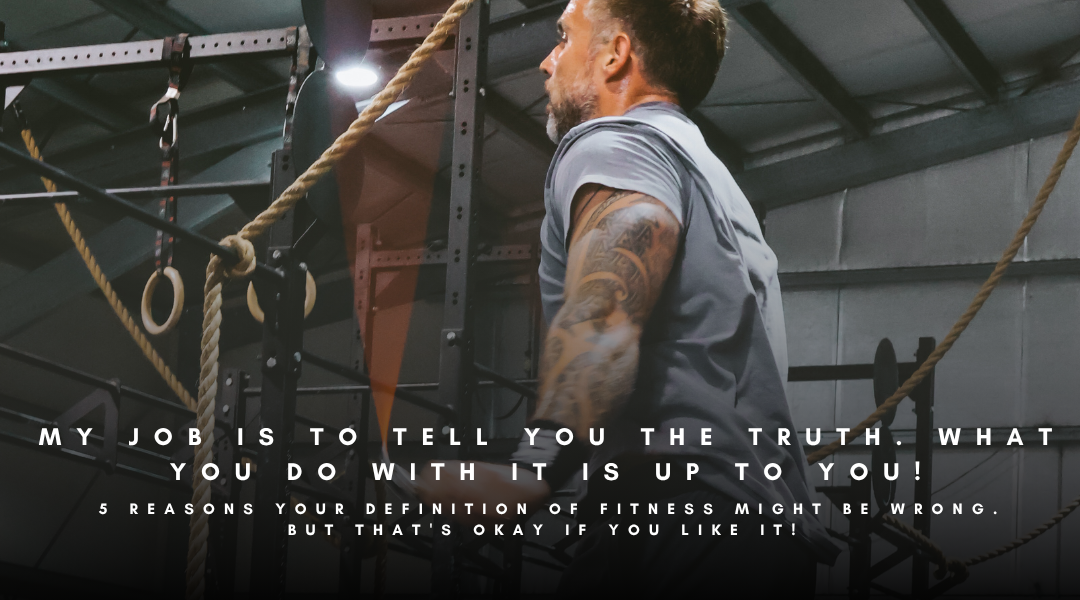
What he said was that as a leader, ‘it’s our job to tell you the truth, and it’s your job to make a decision’.
And it got me thinking about my responsibility as a coach, a business owner, and somebody who genuinely wants to help people live longer, healthier, more capable lives.
As an operator, you would be hard-pressed to find somebody who puts more effort into understanding what they’re saying and doing than I do.
I start my day reading. I spend breakfast listening. Throughout the day, I find small pockets of time to learn, research, question, and deepen my understanding of what I teach.
All in all, I spend roughly two hours every day on personal and professional development.
Now, that means absolutely nothing if the point of telling you this is to convince you how awesome I am.
That’s not the point.
The point is that I don’t think I’m that good. I think I have a responsibility to keep getting better, for myself, but also for you.
Because if I know something that could help you live a longer, healthier, more capable life, and I choose not to share it because it might challenge your beliefs or make you uncomfortable, then I’m not doing my job.
Which brings me to today’s point.
What we do at Vasse Strength and Conditioning is what we believe to be the right way to develop genuine fitness.
It might not be your favourite way to exercise.
It might not be the easiest.
It might not even be the way you want to spend your mornings.
But before you decide CrossFit isn’t for you, I want you to understand what you’re actually saying no to.
Because there’s a difference between exercising, burning calories, getting sweaty, and actually improving your fitness.
And if you don’t understand that difference, you might be spending a lot of time getting tired without getting genuinely fitter. You might get generally fitter, but again not genuinely fitter.
Here are five reasons why CrossFit and Vasse Strength and Conditioning provide such an effective framework for building a body that doesn’t just look fit, but is genuinely fit… And if you think otherwise, you’re wrong.
But that’s okay. 🤷♂️
1. Fitness Has a Definition. And It’s Not How Sweaty You Get.
Let’s start with something that might challenge the way you currently think about fitness.
CrossFit defines fitness as:
“Increased work capacity across broad time and modal domains.”
Sounds complicated?
It’s not.
Work capacity is your ability to do physical work.
Broad time domains mean being able to perform that work for different lengths of time.
Broad modal domains means being able to perform that work across different movements, activities, and physical demands.
Put simply:
Fitness is your ability to do MORE work, across MORE things, for MORE lengths of time.
And the important word here is INCREASED.
Because fitness isn’t just something you have.
It’s something you should be developing.
If you can lift more weight, move faster, complete more work, or sustain effort for longer than you could six months ago, you’ve increased your fitness.
But here’s where I think the modern fitness industry has confused people.
Somewhere along the way, we started measuring a workout’s quality by how exhausted it made us.
How much did you sweat?
How many calories did your watch say you burned?
How sore were you the next day?
How close did you come to throwing up?
And while those things might tell you something about the effort you put into a session, they don’t necessarily tell you whether you’re becoming fitter.
You can burn 500 calories today and burn 500 calories again tomorrow.
You can finish every workout lying on the floor.
You can sweat through three shirts a week.
But if your ability to perform physical work hasn’t improved, what exactly are you developing?
This is where CrossFit’s definition matters.
It gives us something to measure.
And when we can measure something, we can develop it.
We can improve your strength.
Your endurance.
Your power.
Your speed.
Your stamina.
Your ability to perform work across different movements and time domains.
And we can demonstrate that improvement.
The goal isn’t to leave the gym knowing how hard you worked. It’s to leave the gym knowing that the work you’re doing is making you more capable.
That’s genuine fitness.
2. The Method Matters More Than the Workout.
Now that we’ve established what fitness actually means, let’s talk about how we develop it.
CrossFit defines its methodology as:
“Constantly varied functional movements performed at high intensity.”
But there is one word I want you to pay particular attention to when we apply that methodology at VSC.
RELATIVE.
Let’s break that down.
Constantly varied
We expose you to different movements, loads, distances, repetitions, and time domains.
Not because we want to surprise you every morning.
And certainly not because we need to entertain you with something new every day.
But because we want to develop your ability to perform across a broad range of physical demands.
That doesn’t mean random.
We still need structure, progression, appropriate recovery, and a plan.
Variation provides breadth. Programming provides direction.
Functional movements
We prioritise movements that develop useful physical capacity.
Squatting.
Lifting.
Pressing.
Pulling.
Carrying.
Running.
Jumping.
Moving your body through space.
Movements that develop strength, coordination, power, mobility, and the ability to interact with the physical world (CrossFit has 10 general physical skills that encompass all of this; we will discuss later).
We don’t just want you to get better at exercise.
We want the exercise to make you better at life.
Relative high intensity
This is the part people often misunderstand.
Intensity isn’t about everybody doing the same workout at the same speed with the same weight.
It’s about working at an intensity appropriate to YOUR current ability.
A 40-kilogram deadlift might be relatively heavy for one person and a warm-up for another.
A 400-metre walk might be challenging for somebody returning to exercise, while another person might need to run it.
The movement might change.
The load might change.
The repetitions might change.
But the intended training stimulus remains appropriate to the individual.
And as your capacity improves, so does what you can do.
That’s the point of coaching.
Not to make everybody do the same thing.
But to help everybody develop the same thing.
Genuine fitness.
And that’s why I believe so strongly in what we do at VSC.
We don’t just deliver workouts.
We use a methodology to develop measurable physical capacity.
3. Muscle Should Do More Than Make You Look Good.
Wanting to build muscle isn’t just okay.
It SHOULD be one of your fitness goals.
There is absolutely nothing wrong with wanting bigger arms, stronger legs, visible abs, or a physique you’re proud of.
In fact, I’d encourage it.
But why spend years building muscle that serves only one purpose?
We want muscle to serve three.
Metabolism. Aesthetics. Athleticism.
Muscle is metabolically active tissue. It contributes to your resting energy expenditure, supports glucose regulation, and provides an important reserve of physical capacity as you age.
It helps create a physique you’re proud of.
And, perhaps most importantly, it gives you the physical capacity to DO things.
We want legs that can squat, run, jump, and climb.
We want a back that can lift, pull, carry, and support you.
We want shoulders that can press, stabilise, and move through a healthy range of motion.
We want your muscles to have a job.
And we want you to be able to perform that job for as long as possible.
Because here’s something I’ve been thinking about as I approach 40.
I’m glad I’ve spent the last 20 years building muscle.
I’m glad I’ve developed a physique I’m proud of.
But I’m even more grateful for what comes with it.
The ability to run around with my boys.
To lift heavy things.
To compete.
To work.
To play.
To say YES to life’s physical demands without questioning whether my body can do them.
And I want that to continue into my 40s, 50s, 60s, and beyond.
Because the muscle you develop should help you perform physical work for as long as possible.
Not just increase the amount of weight you can move once.
But help you move more weight, for more repetitions, across more activities, for longer periods of time.
That’s why we combine strength training, gymnastics, weightlifting, and conditioning.
We want muscle that contributes to your overall fitness rather than existing independently of it.
Build muscle for the mirror today. Build capability for the life you want tomorrow.
You don’t have to choose just one.
4. You Should Be Training for the Life You Haven’t Planned Yet.
There’s a term in strength and conditioning called General Physical Preparedness.
GPP.
In simple terms, it means developing a broad foundation of physical fitness that prepares you for a wide variety of activities and demands.
Kind of the main point I’m trying to make in this blog.
And where we believe genuine fitness becomes incredibly valuable.
Because life doesn’t care what your favourite exercise is.
It doesn’t care how much you bench press.
It doesn’t care what your five-kilometre time is.
And it certainly doesn’t care how good your abs look.
Life will ask you to do things you haven’t prepared for.
Move furniture.
Carry your kids.
Run after something.
Help somebody who has fallen.
Climb a hill.
Spend an entire day on your feet.
Or simply get yourself off the floor when you’re 80 years old.
And you don’t get to choose which physical skill you’ll need when that moment arrives.
This is why CrossFit aims to develop ten general physical skills:
- Cardiovascular endurance
- Stamina
- Strength
- Flexibility
- Power
- Speed
- Coordination
- Agility
- Balance
- Accuracy
These skills contribute to your ability to perform work across different physical demands.
But developing them isn’t about ticking ten boxes.
It’s about improving the capacity of the person who possesses them.
Imagine somebody who can snatch their bodyweight and run ten kilometres on the same day.
That’s an impressive demonstration of strength, power, coordination, endurance, and stamina.
But here’s the thing.
You don’t need to snatch your bodyweight or run ten kilometres to benefit from the philosophy.
Your version might be a 40-kilogram snatch and a five-kilometre run.
Or your first unassisted squat and a walk around the block.
The goal isn’t to achieve somebody else’s standard.
It’s to keep expanding your own.
Because the more capable you become, the more options you have.
We want you to be strong enough to lift.
Fit enough to move.
Mobile enough to function.
Coordinated enough to adapt.
And physically prepared enough to handle the unexpected.
We train for survival, with a touch of thriving.
Just like life some days.
Survival is being physically capable of meeting the demands of everyday life.
Thriving is having enough capacity left over to enjoy it.
It’s being able to say YES.
Yes to the family adventure.
Yes to the hike.
Yes to the sporting event.
Yes to trying something new.
Yes to another decade of being an active participant in your own life.
Because we don’t want you to spend the second half of your life watching everybody else do the things you wish you could still do.
We want you in the game.
And we want you to have the physical capacity to stay there for as long as possible.
That’s what increased work capacity across broad time and modal domains actually means when you take it out of the gym and put it into real life.
5. Getting a Workout Isn’t the Same as Getting Fitter.
When you first start your fitness journey, doing ANYTHING is better than doing nothing.
Walking. Running. Lifting weights. Group fitness. CrossFit.
Whatever gets you moving and keeps you consistent, DO IT.
Because when you’re starting from very little, almost anything will make you better.
But here’s where things get interesting.
I’ve written about three waves of adaptation in a previous blog, and understanding them might change how you think about your training.
Wave 1: Almost Anything Works.
You start exercising.
You get stronger. You lose some weight. Your cardiovascular fitness improves. You feel better.
And the best part?
You don’t necessarily need a sophisticated training system to achieve these results.
Your body is responding to a new stimulus, and almost any regular exercise can produce improvements.
This is why so many different fitness systems deliver great results for beginners.
But here’s the problem.
What got you results in the beginning isn’t necessarily what will keep getting you results.
Wave 2: What Happens When Doing More Stops Working?
Eventually, those initial improvements slow down.
Your strength plateaus. Your fitness stops improving. The workouts that once challenged you become easier.
And simply showing up and doing another workout doesn’t produce the same results.
This is where progressive overload becomes important.
Not just lifting heavier weights, but progressively increasing your ability to perform physical work.
More repetitions. Greater loads. Faster times. Longer distances. Better movement quality.
The answer isn’t always to work harder. It’s to train smarter.
And this is where the system you’re following starts to matter.
Because while almost any form of exercise can get you through wave one, not every training system is designed to help you progress through wave two.
If your workouts are simply designed to make you sweat, burn calories, and feel exhausted, what happens when your body adapts?
Do you just sweat more?
Burn more calories?
Add another session?
Or does your training have a method for identifying what you need to improve and progressively developing it?
Wave 3: How Long Can You Keep Getting Better?
This is where genuine fitness becomes a long-term pursuit.
The goal isn’t just to break through one plateau.
It’s to build a system that lets you keep progressing for years.
Now, that doesn’t mean perfectly linear progress forever. Nobody achieves that.
But a functioning training system should give you opportunities to keep developing your physical capacity as your life, goals, and abilities change.
And this is where I believe the CrossFit methodology becomes incredibly valuable.
Because we’re not measuring progress through one exercise, one number, or one physical quality.
We’re developing work capacity across broad time and modal domains.
Remember those ten general physical skills?
The goal is to keep developing your capability across ALL of them.
When your strength plateaus, there may still be opportunities to improve your endurance.
When your endurance improves, we can develop your power.
When your power improves, we can revisit your strength, coordination, mobility, or ability to sustain effort.
There is always something worth developing.
And your training system should be capable of identifying it, measuring it, and helping you improve it.
So, What Does This Mean for Your Workout System?
Imagine you attend a group fitness class or work out three times a week.
Every session is different. Every session is challenging.
You sweat. You burn calories. You feel fantastic afterwards.
GREAT!
But six months later, can you lift more? Run further? Perform more repetitions? Complete the same workout faster?
Can you do things you couldn’t do before?
And more importantly…
Does the system you’re following have a plan to help you keep improving when those initial results slow down?
Because that’s the difference I want you to understand.
At VSC, we don’t just want to get you through wave one.
We want to help you navigate wave two and continue developing your physical capacity throughout wave three.
That’s why we incorporate structured strength training, Olympic weightlifting, gymnastics, and cardiovascular conditioning.
It’s why we repeat benchmarks, measure progress, and individualise training.
And it’s why not every workout needs to leave you exhausted.
Sometimes the best thing you can do is lift something heavy.
Sometimes it’s developing a skill.
Sometimes it’s moving at a controlled pace for 40 minutes, or just going for a run.
Sometimes it’s recovering so you can come back stronger tomorrow.
The goal isn’t to win today’s workout. It’s to become a fitter person over time.
And that requires more than just a good workout.
It requires a functioning training system that develops all ten general physical skills and continues increasing your work capacity across broad time and modal domains.
Because without that, you might still be fit.
You might look great.
You might enjoy every session.
And there’s absolutely nothing wrong with that.
But are you still developing genuine fitness?
Are you building a body that can do MORE, across MORE things, for MORE years of your life?
That’s the difference between getting a workout and developing genuine fitness.
And that’s why we do things the way we do at VSC.
So, What’s the Point?
Here’s what I want you to take away from all of this.
I don’t believe everybody has to love CrossFit.
I don’t believe everybody has to train at VSC.
And I certainly don’t believe somebody who chooses to run, swim, cycle, lift weights, go to another gym, or do another type of small-group training is making a bad decision.
There are plenty of ways to improve your health and fitness.
And if you’ve found something you love, I genuinely hope you keep doing it.
But I do believe everybody should understand what they’re trying to achieve before deciding how they’re going to achieve it.
Because fitness has a definition.
Increased work capacity across broad time and modal domains.
And CrossFit provides a methodology designed around developing it.
Constantly varied functional movements performed at relatively high intensity.
Not random workouts.
Not sweating for the sake of sweating.
Not chasing the highest calorie burn on your watch.
Not trying to become a professional athlete.
And not making everybody do the same thing regardless of their ability.
It’s about using a structured, measurable, individualised approach to developing broad physical capacity.
Strength.
Endurance.
Power.
Stamina.
Mobility.
Coordination.
And everything in between.
A body that doesn’t just look fit.
A body that can demonstrate its fitness.
A body that allows you to participate in life rather than simply observe it.
That’s what we’re building at VSC.
And CrossFit was the catalyst for that philosophy from the very beginning.
We don’t want to be the place you come to burn calories. We want to be the place you come to build capability.
Because you burn calories in a session.
Capability is developed over a lifetime.
And that’s what I believe is worth pursuing.
My Job Is to Tell You the Truth. What you do with it is up to you.
I started this blog by telling you about my responsibility as a leader and a coach.
I spend time learning because I believe I’m responsible for understanding what I teach.
I teach because I believe you deserve to understand why you’re doing what you’re doing.
And I tell you what I believe to be true because I respect your ability to make your own decisions.
You might have read this entire blog and already decided that CrossFit isn’t for you.
That’s okay.
You might love running.
You might love bodybuilding.
You might prefer training alone.
Or you might love your current group fitness classes because they’re fun, social, and give you a reason to get out of bed in the morning.
And I genuinely hope you keep doing them.
Because enjoying what you do is an important part of sticking with it.
But if you’re still trying to work out what fitness should look like for you…
If you’re tired of starting again…
If you want to build muscle, improve your health, become stronger, develop your fitness, and actually understand WHY you’re doing what you’re doing…
Then perhaps it’s time to experience what we do at VSC.
Not because I want you to become a CrossFit athlete.
But because I want you to become a more capable version of yourself.
Come and experience the difference between getting a workout and developing genuine fitness.
Hope to see you in the gym soon.
Get up.
Get after it.
BECOME EXTRAORDINARY.