I’ve been in the fitness industry for over twenty years now.
Twenty-two to be precise.
When I first started, exercise had a very clear purpose.
Fight obesity.
You burn calories.
You lose weight.
You lose weight; you shrink your waistline.
This all moves the number on the scales.
Obesity is being beaten!
And at the time, that focus made sense. Obesity was on the rise, and exercise was positioned as the primary solution. In many ways, obesity still definitely still matters. Excess body fat carries real health risks and cannot be ignored.
But as the years have passed, and especially now in 2026, it’s become clear that weight alone tells us very little about how someone is performing health-wise. And although it is important to manage weight, we can use other metrics to help people perform as they age.
Because what I want to point out in this blog post is that what I’ve seen repeatedly over two decades of coaching is this:
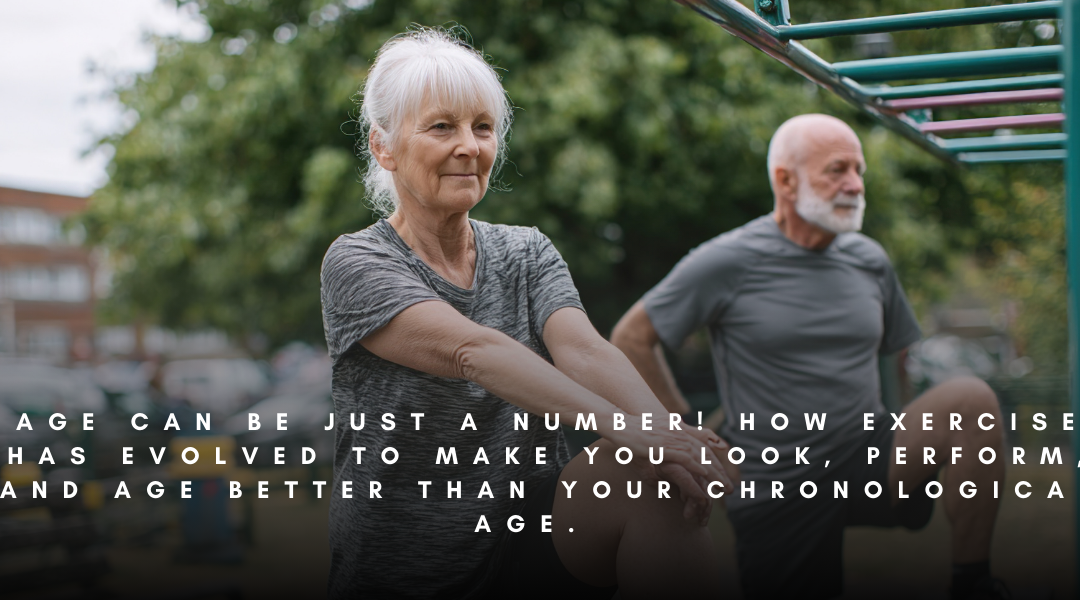
You can be lighter and still be ageing fast.
And you can be heavier, stronger, fitter, and biologically younger than your birth certificate suggests.
Chronological age is simple. It’s the number of years you’ve been alive.
Biological age is different.
It reflects how old your body actually behaves.
What we really need to be concerned with over everything is
The condition of your heart and lungs.
Your muscle mass and strength.
Your metabolic health and insulin sensitivity.
Your hormonal profile.
Your inflammation levels.
Your joints and mobility.
Your nervous system and mental resilience.
Two people can be the same age on paper and live in completely different biological realities.
If you are reading this blog, and especially over the age of thirty-five, it is worth noting that exercise stops being about calories burned and fat lost as we enter the back end of what they call ‘midlife’ or at least they should.
Those outcomes still matter, but they are secondary. They are by-products.
The primary role of exercise needs to become about the messages your hormones start to send to your biology.
Large population studies and lab-based testing consistently show that training three to four times per week at moderate to high intensity can meaningfully shift the markers that determine biological age.
- Cardiovascular capacity can improve by ten to twenty-five percent.
- Strength and muscle mass can increase to levels equivalent to reversing five to ten years of age-related decline.
- Insulin sensitivity often returns to levels seen in people a decade younger.
- Risk of chronic disease and early mortality drops significantly.
This is where the idea of becoming five to ten years younger biologically comes from.
And in some cases, the shift can be even greater than this.
The good news for some is that the biggest changes tend to happen when someone who has been sedentary or inconsistent begins training with real intent.
Not just moving but actually training. Lifting weights that challenge them. Elevating heart rate regularly. Progressing over time. Recovering properly through sleep, nutrition, and stress management. Being more human!
It’s not uncommon to see a forty-five-year-old who commits to structured strength and conditioning for twelve to twenty-four months testing closer to thirty-five to thirty-eight biologically.
Walking is good.
Movement is necessary.
But intensity is what tells the body it’s still required.
Resistance training signals muscles and bones to stay strong and dense.
Conditioning challenges the heart and lungs to remain efficient.
Progression keeps the nervous system sharp and responsive.
To be the bearer of bad news… some need to hear this!
No intensity leads to maintenance at best.
More often, it leads to slow biological ageing while chronological age keeps marching forward.
It is intensity mixed with consistency is what creates reversal.
The uncomfortable truth is that ageing, and being more affluent without movement, is what causes large losses of function.
Being Sedentary causes:
- Loss of muscle.
- Loss of aerobic capacity.
- Loss of metabolic flexibility.
- Loss of resilience and bounce back
- Loss of confidence in one’s own body, both physically, but most importantly, emotionally!
These are not inevitable consequences of getting older.
They are optional trajectories.
When I first entered the industry, the options were fairly blunt.
You either lifted weights in a gym.
You did excessive cardio or aerobics-style classes.
Or you hired a personal trainer who pushed you as hard as possible, often without structure, progression, or long-term thinking, and for nowhere near the fees personal training commands today.
It was effort-driven, not system-driven.
Sweat more. Burn more calories. Push harder.
For a time, that was enough.
But the good news is that fitness has evolved.
Today, we have smarter, more intentional systems.
Strength and conditioning facilities like ours focus on long-term capability, not short-term exhaustion.
Pilates in multiple forms, including bike-based and pool-based formats.
Circuit facilities are built around structure and progression.
Conditioning programs are designed to support heart health, strength, and resilience.
Most importantly, we now understand that exercise is not just a physical transaction.
It’s emotional.
It’s psychological.
It’s social.
Community has become part of the prescription.
Confidence has become an outcome.
Capability has become the benchmark.
Fitness is no longer about punishment.
It’s about preparation.
Preparation for work.
For family.
For stress.
For ageing well.
What I love is that the conversation has shifted away from weight alone now and toward the capabilities of our biological age.
Because the goal is no longer just to look better.
It’s to live longer, perform better, and function better for longer, because ageing is inevitable, but does not need to be degenerative.
And this is the part that needs to be said clearly.
Sedentary lifestyles are not helping your biological age.
Highly processed food is not helping your biological age.
Alcohol-fuelled weeks balanced by maybe one hard workout are not helping your biological age.
One intense session per week is not enough.
Occasional effort does not reverse decline.
If we’re being honest, the reality is simple.
To influence biological age in a meaningful way, most people need to eat well at least eighty percent of the time and train with intent at least twenty percent of their week.
That means three to four training sessions per week.
Not once.
Not when life is calm.
Not only when motivation is high.
More often is better.
Consistency beats intensity done occasionally.
And this is the reality most people don’t want to hear but need to.
To clear this up, our mission at Vasse Strength and Conditioning is not to train people simply to burn calories or chase aesthetics.
We train people to influence their biological age.
What they can do, not just what they look like.
To stay strong enough to lift, carry, and move with confidence.
To maintain lungs and a cardiovascular system that support effort under stress.
To keep joints moving freely.
To preserve energy, independence, and resilience.
Looking good is a bonus.
Fat loss is a by-product.
Fitness is a side effect.
The real outcome is slowing, stopping, or even reversing unnecessary biological ageing.
Chronological age will keep moving forward.
Biological age does not have to.
Exercise and a healthy lifestyle are the prescription.
That is what modern exercise makes possible.
So the time is now.
Get up.
Get after it.
Become extraordinary.