One thing you probably don’t know about me is that before Vasse Strength & Conditioning ever existed, before coaching and programming and early mornings in the gym, I was a tradie.
A plasterer’s labourer, and Airbnb cleaner to be precise.
Long days. Heavy loads. Repetitive work. Awkward positions. Early starts and sore hands, omg sore hands, and the odd lime burn.
I’d spend hours carrying mud, mixing, lifting overhead, twisting, crouching, climbing, cleaning, and bending. Then I’d finish the day and still go and train, or it may have already been done before work.
At the time, it just felt like what I did.
In hindsight, I thank God I did.
Because looking back now, I honestly don’t think I could have done those jobs properly, or for very long, if I hadn’t been training. Not at full capacity. Not without pain. Not without something eventually breaking down.
And also the irony is…
That period of my life, where I was working the most physically demanding jobs I’ve ever done, was also the fittest I’ve ever been.
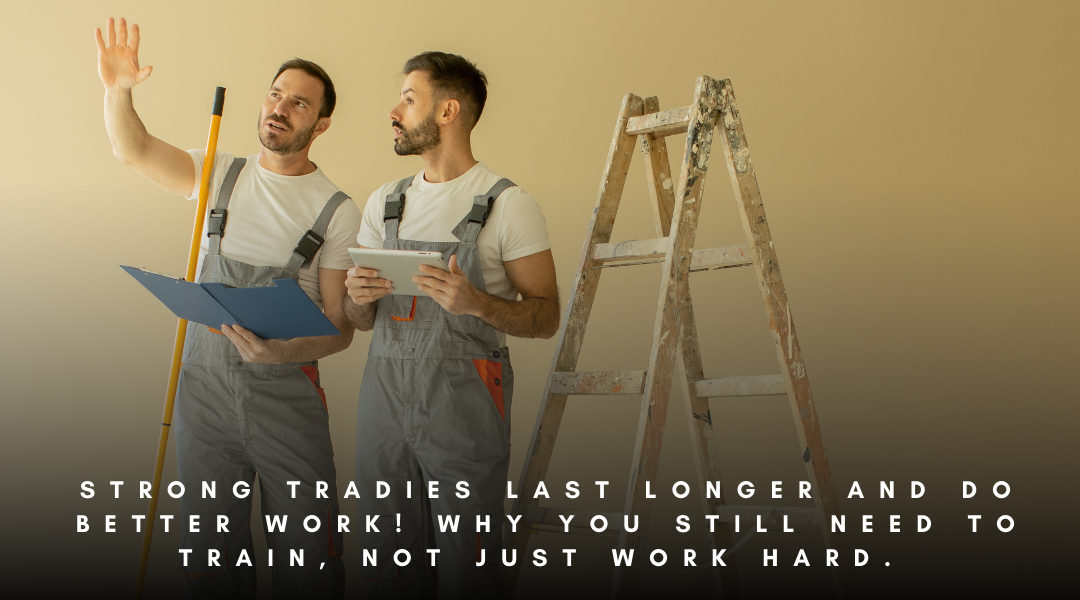
Which brings me to a myth, and bit of a topic of conversation I want to bring up in this blog post, that I believe still runs deep in the trades that…
“There’s no point training. I work hard all day. I don’t need the gym.”
On the surface, it makes sense.
You’re lifting, carrying, bending, twisting, climbing, crawling. You go home tired. You’ve earned the couch.
But the truth most don’t realise until it’s too late is that hard work is not the same as smart strength. And that “active” is not the same as “prepared”.
In fact, the very thing that makes you good at your trade, repetition, consistency, doing the same movements day in and day out, is the same thing that quietly breaks your body down.
Most RSIs don’t come from one big moment.
They come from:
• The same shoulder angle, thousands of times a week
• The same spinal position under load
• The same grip, the same stance, the same rotation, over and over again!
Your body adapts to what you repeatedly ask of it.
But adaptation without balance is how joints wear down, and degenerate, not how they get stronger.
Training does three things your job doesn’t:
- It strengthens you in ranges you never use at work
Overhead stability, hip extension, rotational control, core bracing, single-leg strength. - It builds tissue tolerance
Stronger muscles protect tendons. Stronger tendons protect joints. Stronger joints protect careers. - It teaches your nervous system better movement patterns
So when fatigue hits on site, your body still knows how to brace, hinge, rotate and stabilise properly.
That’s not aesthetics.
That’s longevity.
That’s being able to work pain-free at 45, 55, 65 (when you now have a big team and don’t have to be on the tools anymore… surely!) not just push through until something “goes”.
Another myth to dispel is that being active all day won’t lead to weight gain.
I’ve heard it from tradies at the pub, in conversation and at events when the gym comes up.
“If I’m on my feet all day, always moving, I can’t get unfit and definitely won’t get fat.”
But the body adapts quickly. It is a trap!
What was once demanding becomes normal.
Your heart rate drops.
Your calorie burn drops.
Your metabolism becomes efficient, which in modern life means it stores, not spends.
Add to that:
• Long hours
• Stress
• Convenience food
• Poor sleep
• Dehydration
• Zero high-intensity output
And suddenly the “hardworking bloke” slowly becomes:
• Stiffer
• Heavier/Flabbier
• More inflamed
• More tired
• More reliant on coffee, sugar, and painkillers
Not because he’s lazy.
But because monotony without intensity is a recipe for metabolic slowdown.
Training reintroduces a stimulus that what work no longer provides:
• Short, sharp intensity
• Full-body demand
• Hormonal stimulus
• Real cardiovascular challenge
• Muscle mass preservation (which keeps your metabolism high)
The fact is, the best tradies and the ones worth the best dollars for their time aren’t just skilled with their hands.
They’re:
• Hard to fatigue
• Hard to injure
• Hard to slow down
• Hard to replace
They don’t train to look good in a mirror.
They train to:
• Carry better
• Brace better
• Last longer
• Recover faster
• Stay in the game
The are determined and reliable, fit and healthy, because they understand something most learn too late…
That their body is their primary tool. And unmaintained tools wear out.
So, the question is, are you playing The Long Game?
You don’t train because your job is easy.
You train because your job is demanding.
You don’t lift to add stress.
You lift to become resilient.
And you don’t move with intensity just to “burn calories.”
And you don’t train hard to get lean.
You train hard so your nervous system, joints, heart and lungs can still handle long days, heavy loads and pressure when you’re 50, not just 30.
Good tradies don’t stop training when they start working.
They start training because they work.
Because strength isn’t optional when your livelihood depends on your body.
It’s the difference between
• Getting through the week
• And owning your life for decades.
The Bottom Line is simple.
The world runs on trades.
And the work will take whatever your body can’t protect.
It will take your back if it’s weak.
Your shoulders if they’re unstable.
Your hips if they’re tight.
Your energy if your engine is under-powered.
Training is how you stop the job from taking what you can’t afford to lose.
Plus, you have a career! The goal isn’t just to be a good tradie today.
It’s to be a capable man at 40.
A pain-free father at 50.
A strong, independent human at 70.
That doesn’t happen by accident.
It happens by building a body that’s harder to wear out than the job trying to wear it down.
So get up. Get after it. Become Extraordinary.